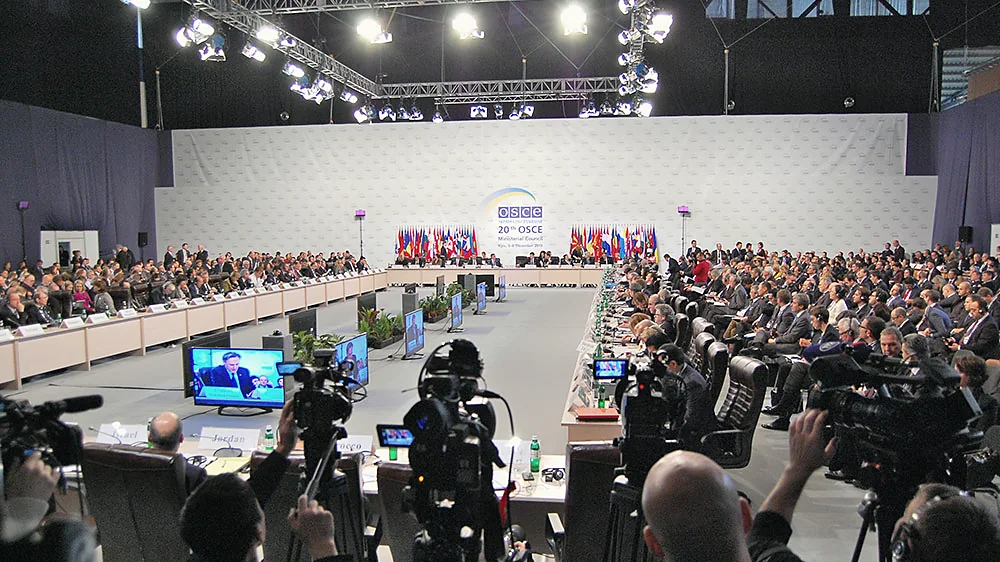
The OSCE Ministerial Council at the IEC in December 2013
WRITTEN
UPDATED
In December 2013, people came to the International Exhibition Centre for something other than an industrial forum or a trade fair. Diplomats met here, foreign ministers gave speeches, and European security was on the agenda.
On 5–6 December, the IEC hosted the 20th Meeting of the OSCE Ministerial Council. For Ukraine, it was one of the main events of its year chairing the organisation. For Kyiv, the meeting came at a moment when the world’s attention was already fixed on the Euromaidan.
That is why this meeting cannot be told through the official agenda alone. For those two days, international diplomacy and events in Ukraine were very close to each other.
In 2013, Ukraine held the Chairmanship of the Organization for Security and Co-operation in Europe. The duties of OSCE Chairperson-in-Office were performed by the then Minister of Foreign Affairs, Leonid Kozhara.
The December meeting was an opportunity to sum up the Chairmanship and agree on further work. Representatives of 57 participating States, 11 Partners for Co-operation and international organisations came to Kyiv. These figures were given by the OSCE in its announcement of the meeting’s opening.
What is discussed at such a meeting? Security here covers much more than military issues. The Kyiv agenda included protracted conflicts, human rights, transnational threats, energy and the environment. This explains why, alongside diplomatic negotiations on conflict settlement, there were discussions of freedom of religion and protecting people from human trafficking.
02 / VENUEIEC
How the IEC worked during the international meeting
The venue was the International Exhibition Centre on Kyiv’s Left Bank. The official press guide listed it at its address at the time: 15 Brovarskyi Avenue.
A media centre was set up for the event, with workstations for journalists and civil society representatives, and rooms for interviews and briefings. Television and radio booths were to receive video and audio feeds from the sessions. Access to the premises required accreditation.
These details from the OSCE media guide clearly show how the purpose of the exhibition space changed. For the duration of the meeting, the IEC became a place where delegations, the press and the organisers of an international event all worked at the same time.
03 / PARTICIPANTS57PARTICIPATING STATES
Who represented the states and the OSCE
The meeting brought together foreign ministers and other heads of delegation. Among the participants were German Foreign Minister Guido Westerwelle, Russian Foreign Minister Sergey Lavrov and US Assistant Secretary of State for European and Eurasian Affairs Victoria Nuland.
Speakers on behalf of the OSCE included Secretary General Lamberto Zannier and Parliamentary Assembly President Ranko Krivokapić. Ukraine was also represented at the opening by Prime Minister Mykola Azarov.
This was specifically a meeting of the Ministerial Council, not a summit of heads of state. The level of representation varied between delegations, as can be seen from the official programme and published statements.
04 / CONTEXT5 Dec 2013
The Euromaidan as the meeting’s backdrop
By early December 2013, mass protests were already under way in Ukraine. They began after the government decided to suspend preparations for signing the Association Agreement with the European Union. Subsequent violence against protesters and journalists drew even more attention to the situation.
Foreign delegations arrived in the capital at exactly this time. A US Helsinki Commission piece on the Kyiv meeting notes that the protests became one of the defining themes of its political context.
On 5 December, representatives of the “Stop Censorship!” movement and the Eurorevolution held a demonstration outside the IEC. Activists handed foreign delegations an appeal in English along with photos of beaten journalists. They called for attention to the events of 30 November and 1 December and for observers to be sent to Ukraine.
According to a report by Detector Media at the time (in Ukrainian), the appeal was handed over by, among others, Oksana Romaniuk and Nataliia Sokolenko. In this way, civic activists tried to bring to the participants’ attention what was happening outside the official meetings.
05 / OUTCOMES6 Dec 2013
What was decided in Kyiv
At the end of the meeting, the participants agreed on documents in several areas. Among them:
01Combating human trafficking. The participants agreed on further steps within the OSCE’s work to prevent this crime.
02Freedom of thought, conscience, religion or belief. A separate decision concerned the protection of these rights.
03The rights of Roma and Sinti. The document paid particular attention to women, young people and children.
04Energy and the environment. The decisions covered the environmental impact of energy-related activities and protecting energy networks from natural and man-made disasters.
05The Transdniestrian settlement. A ministerial statement was adopted on the negotiation process in the “5+2” format.
The participants also supported continuing the “Helsinki+40” process, linked to the approaching fortieth anniversary of the Helsinki Final Act.
The official OSCE summary describes these agreements as the result of the Kyiv meeting. At the same time, adopting documents did not automatically solve the problems they addressed.
06 / NO DECISIONNo consensus
What could not be agreed
Not every issue ended in a joint decision. According to the UK government’s statement after the meeting, the participants failed to reach consensus on a document on the safety of journalists. A ministerial declaration on Afghanistan could not be agreed either.
That is why statements by individual delegations, activists’ appeals and adopted documents should be kept distinct. A public statement by one state’s representative did not mean a common position of all OSCE participants.
This was especially striking on the issue of journalists’ safety: outside the exhibition centre, activists were handing over evidence of violence against media workers, yet no joint decision on the subject emerged from the meeting.
07 / SUMMARYIEC
The event’s place in the IEC’s history
The OSCE Ministerial Council meeting added a diplomatic chapter to the IEC’s history. The complex welcomed delegations from dozens of states and provided the space for an event followed far beyond Ukraine.
At the same time, the memory of December 2013 is bound up with the circumstances in which the meeting took place. Inside the IEC, international security and human rights were being discussed. At that very moment, Ukrainian society was demanding the protection of those same rights in its own country.
For the exhibition centre’s history, this is an important episode: it shows how a single building can become the setting for events of very different scale and substance.