
EUROVISION

Eurovision 2017 at the IEC: from Jamala’s victory to the contest in Kyiv

WRITTEN
UPDATED

For most of us, Eurovision means voting, dazzling performances and waiting for those famous twelve points. But behind a few evenings of live broadcast there is a whole host city and a venue that has to accommodate a stage, an audience, delegations and hundreds of people behind the scenes.

In May 2017, that venue was the International Exhibition Centre on Kyiv’s Left Bank. The pavilions that usually showcased industrial equipment and hosted business matchmaking were turned into a television arena. What’s more, this arena had to look different every evening, adapting to dozens of musical acts.

How did Eurovision end up at the IEC? The story began a year before the Kyiv final, in Stockholm.

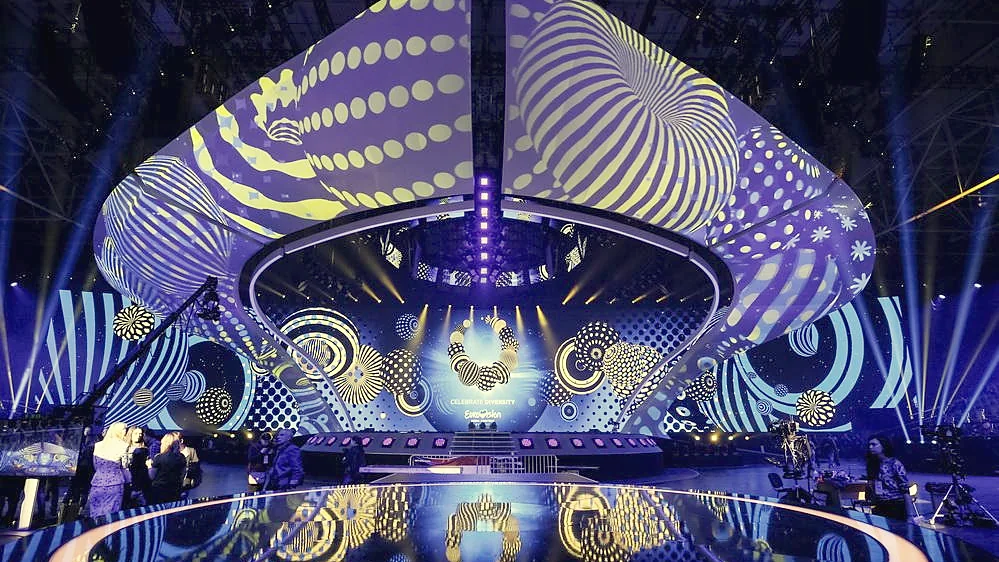
The Eurovision 2017 stage at the International Exhibition Centre in Kyiv: a large arch with projections and a round stage platform
The Eurovision 2017 stage at the IECSource: https://kyivtime.co.ua/
01 / STOCKHOLM 14 May
2016

Jamala and the victory with “1944”

On 14 May 2016, Jamala won Eurovision with the song “1944”. In the final, the Ukrainian singer received 534 points. It was this victory that gave Ukraine the right to host the next contest.

The Ukrainian delegation with blue-and-yellow flags on the Eurovision stage
The Ukrainian delegation with flags on the Eurovision stageSource: © eurovision.tv, Andres Putting (EBU)

Behind the song’s title lay the tragic story of the deportation of the Crimean Tatars. Jamala drew on family memory and the account of her great-grandmother, who was forcibly deported from Crimea together with her children. In this way, a personal story was heard by an international audience.

In a contest people usually discuss in terms of stage effects and costumes, the Ukrainian performance made listeners pay attention to the words. Part of the song was sung in Crimean Tatar. For many viewers, it was their first encounter with both the language and the events Jamala sang about.

Ukraine’s victory was officially confirmed by the European Broadcasting Union. And once the celebrations were over, the Ukrainian team faced a very different job: preparing the country to host the next Eurovision.
02 / CHOOSING THE CITY 9 Sep
2016

How Kyiv won the right to host Eurovision

The singer’s victory did not automatically mean the next contest would be held in the capital. Six Ukrainian cities competed for the chance to host Eurovision: Kyiv, Dnipro, Odesa, Kharkiv, Kherson and Lviv. Three made it to the final stage of selection: Kyiv, Dnipro and Odesa.

The task was not simply to pick a city with beautiful views. Participants and delegations had to be housed and provided with transport, and journalists needed proper working conditions. On top of that, a building had to be found that could handle the scale of a television production.

On 9 September 2016, the European Broadcasting Union announced that the contest would take place in Kyiv. The International Exhibition Centre was chosen as the main venue.

For the capital, this was the second adult Eurovision after 2005. For the IEC, it was a first.

03 / VENUE IEC

Why the IEC became the main arena

An exhibition pavilion may seem an unusual place for a song contest. But a large open space has a practical advantage: it can be organised around a specific event.

Eurovision needs a whole system of spaces. While one artist performs, others prepare to go on stage, journalists work in the press centre, and technical crews monitor the lighting, sound and TV picture. And all of this has to run at the same time.

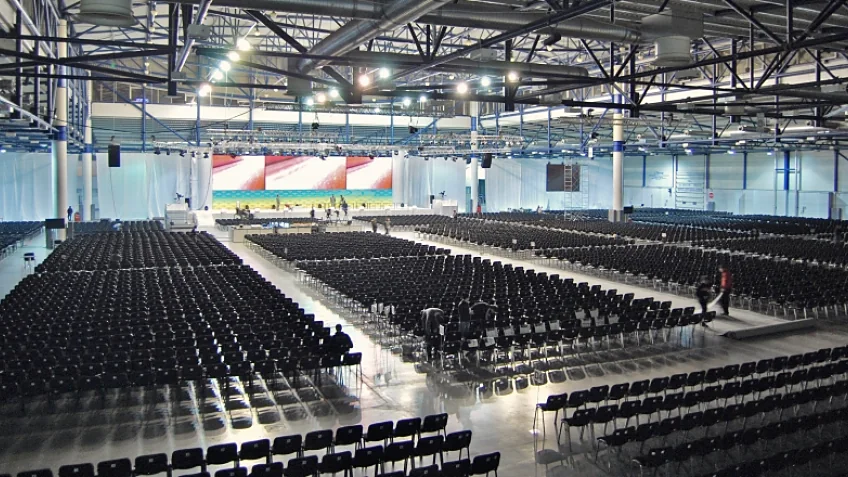
Three pavilions at the IEC were used for the contest. One housed the press centre and areas for delegations and accredited fans. The others held the stage and the audience stands. In effect, the exhibition complex received a temporary layout tailored to the needs of a major show.

A pavilion of the International Exhibition Centre with rows of audience seats, a stage with a screen and steel structures under the roof
An IEC pavilion with audience seatingSource: https://mvc-expo.com.ua/

It also matters that the contest was held in an existing building. The IEC was not built specially for Eurovision: it had opened back in 2002. By 2017, the complex already had experience with exhibitions, forums and international meetings, and now its space had to be adapted for live television.

04 / PRODUCTION Stage

How the exhibition pavilions became a stage

The viewer sees a few minutes of a performance. In that time, the stage can change colour, turn into an abstract landscape or create the illusion of a completely different space. At the IEC, each act had its own lighting and screen design.

The stage was designed by Florian Wieder, who had previously worked on Eurovision in Düsseldorf, Baku and Vienna. According to the organisers, as reported by Ukrinform (in Ukrainian), the stage weighed about 30 tonnes, and the performance area reached 350 square metres.

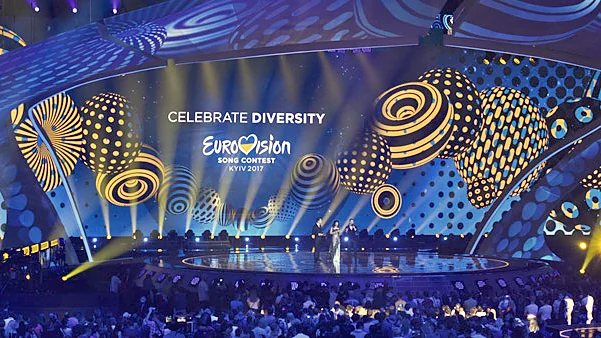
The Eurovision 2017 stage at the IEC with the Celebrate Diversity slogan, the Kyiv 2017 contest logo and the audience in the hall
The Eurovision 2017 stage with the Celebrate Diversity sloganSource: https://mvc-expo.com.ua/

Imagine the space of several flats, filled with sets, equipment and people who have to act with split-second precision. And between acts, everything has to be changed quickly while viewers watch a short clip about the next participant.

The main stage was complemented by a separate platform among the audience. Screens, lighting and camera work made it possible to change how one and the same space was perceived. That is why, on TV, it is not always easy to recognise the same IEC pavilions behind different performances.

05 / LIVE SHOWS 9–13 May
2017

Three Eurovision evenings in Kyiv

The first semi-final took place on 9 May 2017, the second on 11 May. The final was held on 13 May. In total, representatives of 42 countries took part in the contest.

The hosts were Oleksandr Skichko, Volodymyr Ostapchuk and Timur Miroshnychenko. The contest slogan, Celebrate Diversity, reflected the idea of different cultures coming together. Its symbol was a stylised Ukrainian bead necklace, in which each bead had its own pattern.

Ukraine was represented at its home contest by the band O.Torvald with the song Time. As the host country’s entry, they went straight to the final and finished 24th.

The winner was Portugal’s Salvador Sobral with the song Amar Pelos Dois. He scored 758 points and brought Portugal its first victory in the history of its participation in the contest. Bulgaria came second, and Moldova third.

The dates, participants and results are preserved in the official Eurovision 2017 archive.

06 / FINAL 13 May
2017

Jamala at Eurovision at the IEC

In the year between the two contests, Jamala’s role changed. In Stockholm, she was a contestant waiting for the voting results. In Kyiv, she performed as the previous year’s winner, thanks to whom the contest had come to Ukraine.

During the final at the IEC, Jamala performed the song I Believe in U. Her performance was part of the programme between the end of the competing acts and the announcement of the results. It is preserved, among other places, in the archive of the Czech public broadcaster.

In this way, the 2016 victory and the 2017 contest in Kyiv became two parts of the same story. First, a Ukrainian singer drew attention to her song and her family’s memory. The following spring, Ukraine itself welcomed artists and viewers, many of whom were seeing Kyiv for the first time.

07 / AUDIENCE 182 m

How many people watched the contest from the IEC

The scale of Eurovision was not limited to the people sitting in the stands. According to final figures from the European Broadcasting Union, the three live broadcasts from Kyiv reached about 182 million viewers across 42 television markets.

This is the combined reach of the three shows, not the number of people watching the final at the same time. Even so, the scale is impressive: an event in the pavilions on Brovarskyi Avenue had an audience far beyond Ukraine.

For the IEC, Eurovision became one of the most visible episodes in its history. The exhibition complex hosted an event judged not only by the audience in the hall but by millions of people in front of their screens. After the contest, the temporary stage was dismantled, but the IEC’s name remained in Eurovision’s official history as the venue of the 2017 Kyiv shows.

ON OTHER EVENTS AND STAGES OF THE COMPLEX’S DEVELOPMENTThe IEC in Kyiv: the history of the exhibition centre before and after its acquisition by Maksym Krippa